Any time your head feels full, the middle of a busy day or the end of one
Position
Sitting or lying down, in a chair, on the bed or on the floor
Style
A short body scan, one simple picture to rest on, the breath, and three wishes to end. Music underneath
About 10 minutes with Steven Webb's calm voice and music underneath.
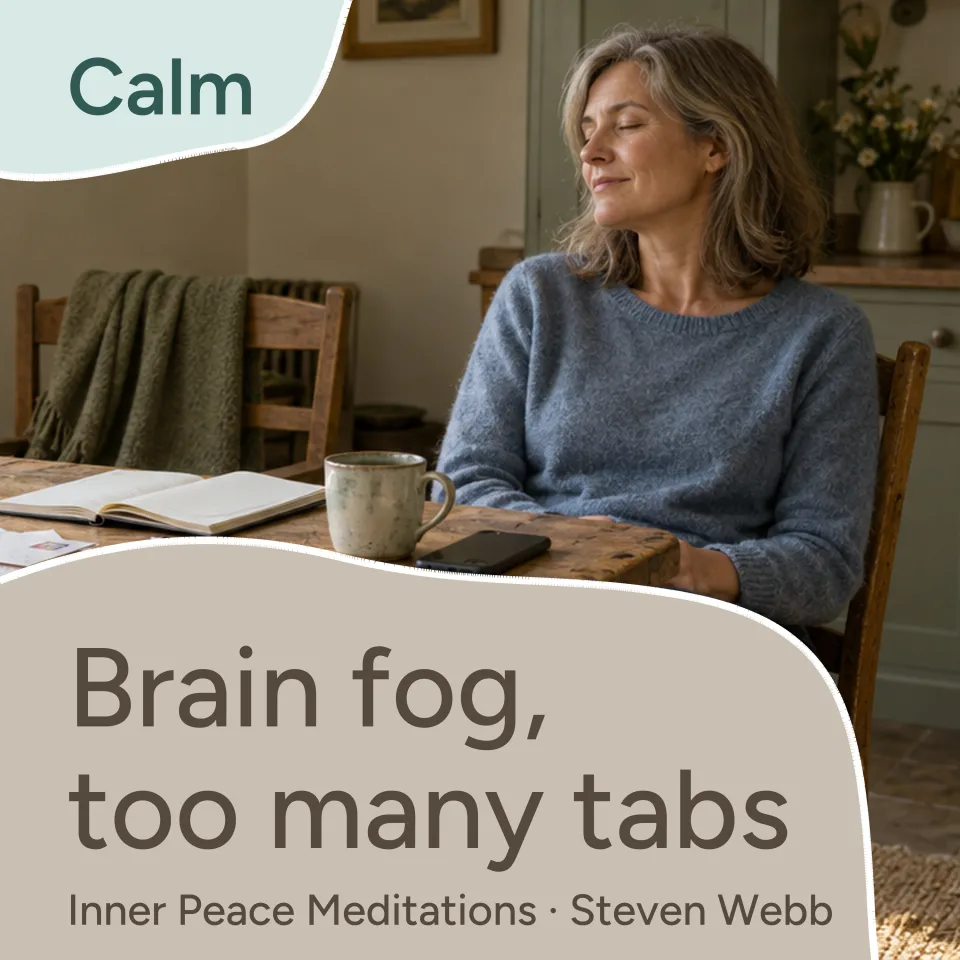
We soften from the top of the head down to the toes. Then I ask you to picture a big, plain wooden table, old and sturdy, and put everything from today on it. The messages, the plans, the things you said and the things you meant to say. Nobody has to sort any of it. Thoughts come and go, and the table stays. We rest on the breath, coming back again and again, and finish with three gentle wishes for a busy mind. A scattered mind isn't broken. It's busy, and that's a lot for anybody.
Who this is for
Brain fog. Too many tabs open and no idea which one is playing the music. You can't think straight, you keep losing the thread, and you tell yourself you should be able to hold it all together.
This meditation is for that day. You don't need to fix anything and you don't need to quieten anything. A scattered mind isn't broken. It's a busy mind, trying to keep track of everything, and that's a lot for anybody. So we give it something simple instead.
What happens in this meditation
You let your eyes close, feel what is holding you up, and soften from the top of your head down to your toes.
Then you picture a big plain wooden table, old and sturdy, and put everything from today on it. The messages, the plans, the things you said and the things you meant to say. Nobody has to sort any of it. Things come and go on the table, and the table stays.
You rest on the breath for a while, and it ends with three short wishes and a gentle count back from five.
How to get the most from it
About ten minutes, with my voice and music underneath. Sit or lie down, whatever lets you feel supported.
There's a quiet stretch in the middle. If a thought pops up, put it on the table. There's plenty of room.
Do it for a few weeks and it gets easier. You'll know where the table is, and you'll know the way back to the breath.
Questions people ask
What if my mind keeps wandering?
It will, and that's fine. That's what the mind does. Notice it and come back, again and again. Every time you come back is a small bit of calm.
Will this clear my brain fog?
It may not, and that's all right too. Sometimes the mind is still busy afterwards, but you're a little kinder to it. That counts.
What are the three wishes?
May I be gentle with my busy mind. May I do one thing at a time when I can. May I know I can always come back to this breath. You say each one twice, slowly.
The transcript
Read alongIt follows the audio. Press any line to jump there.
Hi, I'm Steven Webb.
Welcome to our meditation for when your brain is all over the place, sometimes commonly known as brain
fog.
For the days we have too many tabs open and no idea which one is playing the music.
You don't need to fix anything.
You don't need to quieten anything.
Just become aware.
Your body knows how to breathe.
Your body knows how to settle.
We're just going to allow these things to happen.
Let your eyes close or rest your gaze a few feet in front of you.
Feel what is holding you up, the chair, the bed, or the floor.
It can carry you a little bit more.
And just invite your body to soften so there's no longer an edge.
Start from our top of our head, our forehead and eyes, nose and our cheeks, our jaw and our neck, shoulder
and our arms.
Just allowing them to relax as you go down over them.
Your chest and your belly and your bum.
Your legs.
Even your ankles and toes.
Breathing in calm, breathing out relaxed.
Now a thought about the thoughts.
When your mind is scattered, we often think something has gone wrong, that we should be able to hold it
all together.
But a scattered mind is just a busy mind.
It is trying to keep track of everything, and that is a lot for anybody.
So let's give it something simple.
Picture a table, a big plain wooden table.
Something that's old and sturdy, and on it everything that has been in your head today.
The messages, the plans, the things you said, the things you meant to say.
All the little things that gone wrong, all those people that you judged or you felt judged by, all those
little things you should have done, all those thoughts that were stacking up about tomorrow and the next
day.
Everything's on the table.
We don't need to pick any of it up.
We don't have to sort it.
It can just lie there on the table for a minute and we can sit beside it, and notice that the table is
steady.
And notice even on that table, things come and go.
The table stays.
Now bring your attention to your breath.
Not to change it, just to rest on it.
And when the mind wanders off, and it will, that's fine.
That's what the mind does.
Just notice and come back.
Breathing in calm, breathing out relaxed.
And coming back to this whole practice, not once, but again and again.
Every time is a small bit of calm.
I'm gonna leave you, have a moment of quiet, and if things do pop up, just put it on the table.
There's plenty of room.
Now let the table fade.
Notice if anything has shifted.
It may not have, and that's all right too.
Sometimes the mind is still busy, and we're a little kinder to it.
That counts too.
And let's finish with three short wishes, and just feel them deeply throughout your whole body.
And we just slowly say, may I be gentle with my busy mind.
May I be gentle with my busy mind.
May I do one thing at a time when I can.
May I do one thing at a time when I can.
And may I know I can always come back to this breath.
And may I know I can always come back to this breath.
Soon we go back into the day and it will still feel full.
Some of it will still feel too much.
But we know where the table is now, and we know the way back to the breath.
One thing at a time.
That's plenty.
That's all we can do.
So in a moment, I'll guide you back and you'll have this added wisdom.
And if you do this meditation for, I don't know, a few weeks, get used to it, it'll become a natural part
of your day.
Five, just become aware of the room.
Four, gently open your eyes if they're closed.
Three, wiggle your fingers and shake your arms and maybe your toes.
Two, just look around and just take a deeper breath and just...
Yeah, thank you for sitting here with me, and thank you for doing this.
Remember, we've always got our big steady table we can use.
I always really appreciate our time, and you can come back as often as you like.
There's never any adverts on these meditations simply because of kind people that just donate a coffee
and support, and they often listen to me also on Stillness in the Storms.
And you can head over to stevenwebb.uk to listen to that podcast, and you can always reach out at any