Meditation 76 · 8 June 2025 · 14:06

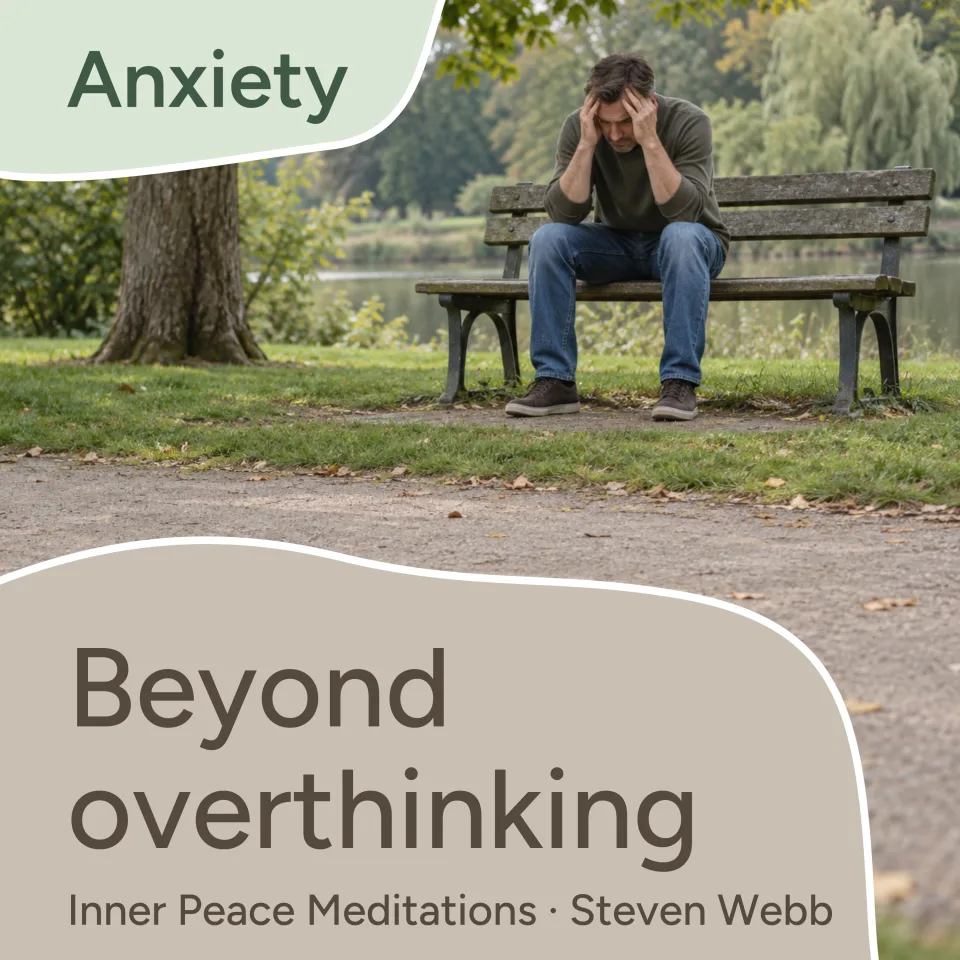
A Dharma Meditation Beyond Overthinking

Shikantaza, which is Zen for just sitting. You do not fight the thoughts, suppress them or work them out. You just stop boarding them.

Subject: Busy Minds & Overthinking

Apple Podcasts Spotify

Inner Peace Meditations · Meditation 76

Length14:06
SubjectBusy Minds & Overthinking
Best timeWhen you have been chewing the same thing for hours
PositionCushion or chair, hands resting
StyleGuided, shikantaza, a platform and some trains. Music underneath

Shikantaza, which is Zen for just sitting. You do not fight the thoughts, suppress them or work them out. You just stop boarding them.

About 14 minutes with Steven Webb's calm voice.

Sit on the platform and let the trains come in. That one is not yours, so you do not get on. Your mind hands you another straight away, and eventually it learns which ones you take. One line does most of the work here: I have thoughts, but I am not those thoughts.

Treat me to a coffee, keep the podcast free, and get my Weekly Calm every Sunday. It is all on stevenwebb.uk

Thank you for sitting with me.

Steven

Who this is for

Overthinking, and the belief that you have to do something about it.

Shikantaza is Zen for just sitting. You do not fight the thoughts, suppress them, or work them out. You stop boarding them, and that is genuinely all of it.

What happens in this meditation

You settle and give the body permission to breathe however it likes.

Then you watch the mind at work without judging it. It is either looking for something or handing you something. That is its job.

One line does most of the work here. I have thoughts, but I am not those thoughts. You cannot be aware of a thing you only are.

Then the platform. Trains come in. That one is not yours, so you do not get on, and your mind hands you another straight away.

Then the attention drops into the body, the legs, the hands, the points of contact, and the mind goes quieter on its own once you stop asking it for anything.

Three lines to finish. May I find peace in the present moment. May I trust in my ability to let go. May my mind be spacious and my heart at ease.

How to get the most from it

Fourteen minutes, sitting rather than lying, because this one wants you awake.

Watch for the trick where you decide the thinking is the practice. Noticing the thought is the practice. Following it is the train.

At the end nothing will have changed. The thoughts are still coming. Knowing you do not have to do anything with them is the whole gain, and it is a large one.

Questions people ask

Is the same worry really coming back?

No. It is a new thought each time, which is why none of them last more than a moment before the next arrives. Nothing that relentless is one thing.

Do I need to know anything about Zen?

No. I name shikantaza and say what it means, and that is the whole of the vocabulary.

What if I keep getting on the trains?

Then you notice, get off, and sit back down. That is not the practice failing. Getting off is the practice.

Listen together

The companion talk

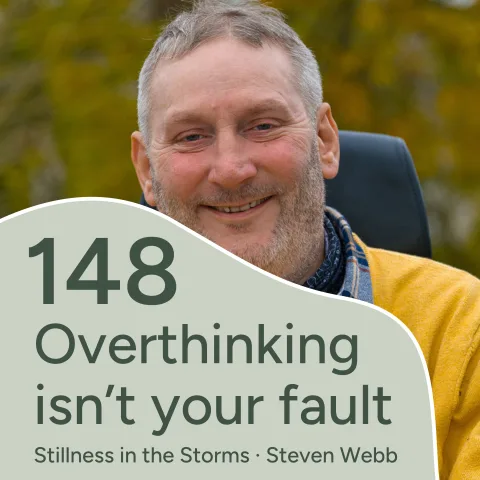
The Stillness in the Storms episode that goes with this meditation.
Read along

The transcript

It follows the audio. Press any line to jump there.

overthinking · buddhism · present-moment

Read the transcript

So, this meditation is to help you just let go of the overthinking. The intention is to

gently shift our awareness from the busy mind to the simple, but yet really profound reality of

just the present moment.

Discovering the peace that is always available to us. It's always available right here. So

find a comfortable posture. Whether sitting on a cushion or in a chair. And just allow your hands to

rest on your lap.

Or whatever position that you feel most comfortable when you're normally meditating. And

you can gently close your eyes or just gently soften them to a few feet in front of you. Whatever

you feel comfortable with.

And just simply give yourself permission to be here. Give

your body permission to breathe. Just the way it wants to.

And your body knows how to breathe just the same as your body knows how to relax.

Just allow it to be what it is.

Allow your body to relax into this moment.

And as you begin to settle in, just take a moment to arrive in this moment. There's nothing you need

to do here nowhere else you need to be. And

often we find ourselves caught up in the mind's constant activity.

And we can easily mistake this for for

who we really are.

So in Zen, there's a concept known as Shikantaza. I think it's pronounced. Which is roughly

translated to just sitting. It points to a simple but yet really profound truth. That we

don't need to do anything to our thoughts. We don't need to fight them, suppress them, or even analyse them.

The invitation is to simply shift our attention.

So just before we continue with the meditation,

It's just worth remembering that when we do have thoughts, when it comes into your head, as they will, that's

what the mind is there to do. It's evolved to think, to protect you, to come up with stuff. We

don't have to do anything with them. And

it's so incredibly simple, but yet so powerful.

So just bring your awareness to your breath.

Notice the natural effortless rhythm of your breath

as it enters and leaves your body.

You don't need to deepen it or change it in any way.

Body knows how to breathe. It's been doing it for a long time without you getting involved.

You may notice the rise and fall of your chest or your belly.

And Just for a moment, notice the activity of the mind.

See if you can observe it without judgement.

Notice that it's just wandering, looking for stuff.

If it's not looking for stuff, it's handing you stuff. It's handing you thoughts.

And you're not the thoughts because you wouldn't be aware of the thoughts if you were the thoughts.

So you can be aware of the thoughts.

A handy little mantra is, I have thoughts, but I am not those thoughts.

I have thoughts, but I am not those thoughts.

And you don't have to do anything with them.

And perhaps it feels like a busy train station. And

sometimes it's like thoughts just coming and going. Or that flywheel just reoccurring worries.

You imagine sat on the platform and trains come and go. Well, if it's not your train, you don't do

anything with it. You

notice the train. Oh, that's not mine. And you just carry on waiting.

And that's what we can do with the thoughts. Ah, that's not a thought I want to get onto.

And then let it go.

Your mind will try to go and get another one.

And eventually it will learn what thoughts you want to get onto.

And if we just bring our moment to the body,

what's the body doing right now?

How are your legs feeling?

How are your feet?

How are your hands?

And you may notice when you move away from the

thoughts and the mind to the body, the mind just quietens down and It's almost like, ah, okay, you're

going to focus on the body, so I'll just go a bit quiet.

You may feel the points of contact with your body, with the chair or the floor. You

may notice some weight and the pressure.

And You bring your awareness to the sensations in your hands, maybe. Are

they warm? Cool? Maybe

there's a tingling? Just

notice. That's

all.

And what if you expand your awareness to all the sounds around you?

Maybe the distant hum of something you can hear.

And all these sounds are part of the present moment.

There's nothing to fix or figure out. There's

just feeling arising. Just hearing is happening And just being is happening.

And as you rest your attention here in the physical sensations, the sounds of the moment,

just notice what's happening with the mind again.

You'll find it's quieter.

It's not fleeting for one thought for another in panic.

So if you just allow your shoulders to relax, the body goes, or the mind goes, okay.

In fact, the body and mind just goes, okay.

Sometimes it might take a couple of instructions.

I think the most important thing is that you don't have to fight the thought. You cannot simply stop the

thoughts by thinking.

And thoughts never last long. They're

a moment, and then poof, they're gone.

If you have a thought that's relentless, it's a new thought every moment. It's

not the same thought.

So we're just going to rest in this awareness just before we come back.

I've got a couple of affirmations. That really might help.

And you can remember these affirmations anytime you want a little bit of peace.

And they go like this. May I find peace in the present moment.

May I trust in my ability to let go.

May my mind be spacious and my heart be at ease.

I'm going to say them one more time and this time really feel them as if they're totally true to

you.

May I find peace in the present moment.

May I trust in my ability to let go.

May my mind be spacious and my heart be at ease.

And now it's just time to really appreciate your body and your mind in this moment. And

the whole universe come together to give you this little bit of peace where

it's nice to think in it

So five. Four, just gently open your eyes. Three, move your arms, wiggle your

fingers and toes. Two, look around the room. One, just take a little deeper breath and just be here and

really appreciate the fact that nothing's changed.

Your mind has not quietened down in any way. Your mind's thoughts are still coming. But

just that knowledge that you don't have to do anything with them,

that's like a superpower.

I have thoughts, but I'm not those thoughts. And

just like that, you take away all of their power, all of their energy, just like that.

Thank you, and I hope you have a wonderful day. Just a gentle reminder that... I put out all these

meditations as part of the Inner Peace Meditations podcast and the Stillness in the Storms podcast.

And we don't have any advertising because I like to listen to the podcast and not the adverts and

But you can support the podcast just by simply treating me to a coffee. That would be amazing. But otherwise,

just share and leave a review. That's amazing as well. Just head over to StevenWebb.uk. You're

awesome and thank you. Have an amazing, peaceful day.

Weekly Calm

One calm email.
Every Sunday.

A little space to pause, a practical thought to take into the week, and a reminder that you’re not doing this alone.

Join and I will send you my book, 5 Simple Practices for Inner Peace. Free, and yours to keep.