When you have been told to let something go once too often
Position
Sitting or lying down
Style
Guided, done with your actual hands. Music underneath
Make a fist round the thing you are clinging to, then open your hand. Notice it does not fly off. That is the whole lesson.
About 11 minutes with Steven Webb's calm voice.
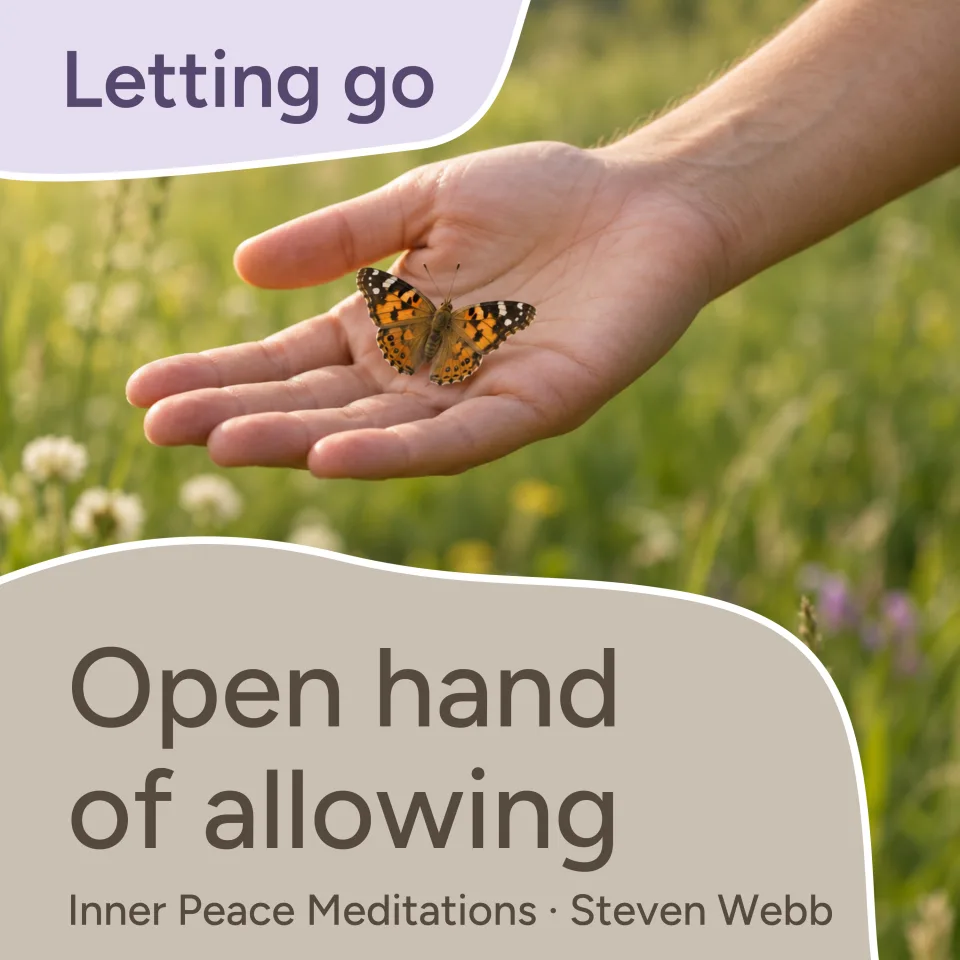
It can be an object, a person, a habit, or just how you think things ought to go. First you feel the grip, actually in your fingers. Then you open the hand and let it sit there like a butterfly, not pushed away and not held. Push at an attachment and it grips harder. Stop pushing and it starts to loosen on its own.
Treat me to a coffee, keep the podcast free, and get my Weekly Calm every Sunday. It is all on stevenwebb.uk
Thank you for sitting with me.
Steven
Who this is for
Something you are clinging to. An object, a person, a habit, or just how you think things ought to go.
You have tried to let it go and it will not budge. This one shows you why, using your own hand, in about thirty seconds.
What happens in this meditation
You bring the thing to mind and feel what holding it is like. Then you make an actual fist around it. Feel the fingers grip, feel the tension.
Then you open your hand and try to push it away. Really try to make it go. Notice what that feels like.
Then the second version. You open your hand and simply allow it to sit there, like a butterfly on your palm. Not pushed, not held. If it wants to stay it can.
Then you compare the two in your body, which is the whole lesson.
How to get the most from it
Eleven minutes, and do the fist for real rather than imagining it. The hand is the point.
Bring something ordinary rather than the largest thing you own. The mechanism is easier to feel when the stakes are small.
Then keep the open hand. You can do that anywhere in four seconds and it works on the spot.
Questions people ask
Why does pushing it away make it worse?
Because pushing is an action, and any action tells the body the thing is important. Your subconscious is not always your friend and it is not always wise.
Will it eventually go?
Often, and not because you made it. When you stop feeding it, the mind quietly moves to whatever is next, and one day you notice it has not been round in a while.
What if I do not want to let it go?
Then do not. That is allowed here, which is rather the point. Allowing is not the same as getting rid of.
Read along
The transcript
It follows the audio. Press any line to jump there.
letting-go · acceptance · visualisation
Read the transcript
Hello. Welcome to the meditation, the open hand of allowing. This is the meditation to help you
just to let go of something that you may be feeling you're a little attached to.
So, just begin by
recognising you're here,
feeling the weight of your body,
and just let your body rest.
Feel your breath as it moves through you.
There's no need to change your breath.
And just let the awareness of your breath remind you that you're right here now.
You're not anywhere else. You
have nothing else to do.
You don't even have to control your breath. You
don't even have to relax your body.
Allow your body to relax and Allow your breath to be what it is.
Allow your shoulders to relax.
Allow your jaw to soften.
You've got nothing to hold up right now.
There's nothing to solve.
Just be here.
Allowing this moment to be what it is.
If a thought or a feeling arises, just recognise I thought And give it a gentle smile and
move back to your awareness of breath.
Breathing in calm. Breathing out relax
Now just gently bring to mind something that you're clinging to.
Could be a object or it
could be some kind of addiction or just a thought or a
person. It could even be a pet.
It could even be just expectations of the future. How things should Be
Or how someone else should be.
And just feel this deeply. What it feels like to be holding on to it What it feels like to
have it in your life.
Now I want you to feel what it's like to be holding it in your hand.
Really tightly in your clenched hand. You're
holding on to it with everything.
And now just feel your fingers gripping. Feel the tension.
This is what it's like to really clench hold of something so what the body's doing. It may
not be quite so noticeable as in your hand this is what you're doing to hold on to something.
And now just very gently, just open your hand
And I want you to
I want you to let it go.
Just imagine trying to push it away from you. It's
really important to you that this is let go, this is gone.
And I want you to notice what that feels like.
That feeling of trying to let something go that won't let go.
Now I just want you to come back to your breath.
Just breathing in calm. Breathing out relax
Just imagine now this thing that you're holding on to.
And you just open your hand again and this time instead of pushing it away, instead of letting it go,
you just allow it to be what it is.
It could be like a butterfly and
you just allow it to be on your hand. You're not trying to
Force it to fly away.
If it wants to stay, it can stay.
And how does that feel in your body this time?
Does it feel much easier? Does
it feel more relaxed?
And this is the thing with attachments and anything we're holding on to.
It's very much when we try to push them away or we try to let go of them. They grab
hold even more.
And the body subconsciously doesn't want to let it go because
there may be some unresolved tension
there may be something else happening.
Sometimes it's so deep that we cannot even see it. And
sometimes it can be really obvious.
But if we, instead of trying to let it go,
instead of trying to do it with an action, if we just allow it to be what it is, the
body and the mind goes, okay,
I'll move on to the next important thing.
And it might be your tea. It might be something
completely different.
But it won't try to force it as a constant. I need to let it go. I need to drop
this. I need to push it away.
And then in time, you'll think about it less. When it does come up, you just go, ah, you're still
here. Okay.
And then in time, the mind and the subconscious mind will just eventually
realise it's gone. It's
no longer part of your life.
So the difference is when we're trying to grab hold of something. And when people are trying to advise us
to let it go, the act of letting go sometimes is what stops you letting it go. Because that
thing doesn't want to be let go of. And
I know that's like a paradox. But that's how the subconscious mind works.
It isn't always your friend. It doesn't always know the wisest thing to do.
Bring your attention back to your breath. Breathing in calm. Breathing out relaxed.
And bring your awareness back to what you can hear.
Maybe the temperature of the room you're in or whether you're outside. You
can feel the seat you're sat on.
You feel the weight of your body.
And just before we come back, just remember the feeling of trying to let something go is almost like that
clenched fists The
forcing of opening it. And
when you just accept the fact that
You can just allow it to be
And then it moves on, that whole feeling is
can be different
So have a deep gratitude for this moment.
Be grateful of your body for indulging in this exercise. The
ego doesn't always like to do things differently.
But now you have a different way of letting things go. Just
by allowing. It's
much easier.
So as I come back from five four just gently open your eyes three shake out
your arms a little bit. Move.
And... Two, look around the room. One, just be really aware of what's going on now and just thank you
for trying something a little bit different today in this meditation
and please let me know if it works and thank you for your support and keeping all these guided meditations
on this podcast completely free. You
can find out ways how to support me and my work by going to StevenWebb.uk. Thank you.