A talk, then a meditation, five short lines. Music underneath
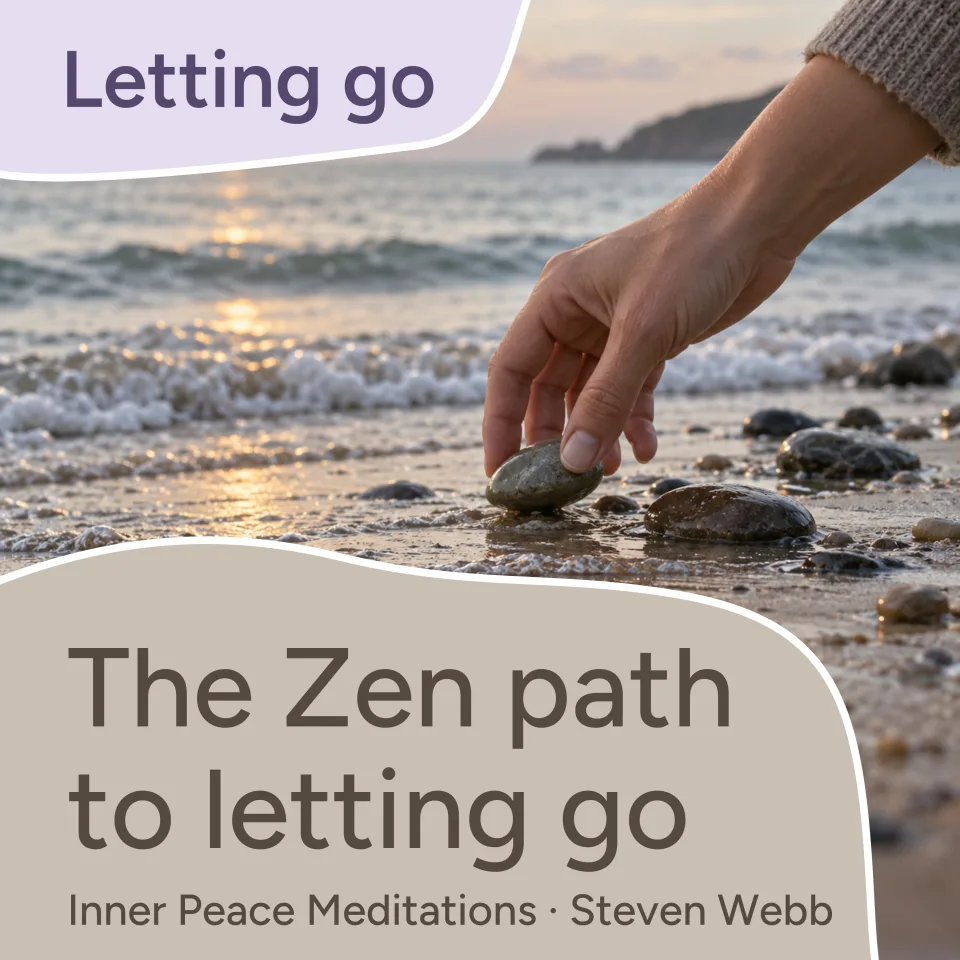
As a boy I filled my pockets with pebbles off Perranporth beach, and I would not let anyone near them. Not even to call them stones.
About 17 minutes, a talk with a meditation at the end.
The West has butchered what letting go means. It does not mean forget it and move on, because you cannot. In Zen it means every moment is arising and you do not have to put it in your pocket. You can enjoy the pebble and leave it there. Not clinging and not pushing away, which is the middle way, and it is the whole of it.
Treat me to a coffee, keep the podcast free, and get my Weekly Calm every Sunday. It is all on stevenwebb.uk
Thank you for sitting with me.
Steven
Who this is for
Anybody who has been told to let go of something and found the instruction useless.
The West has butchered what that means. It does not mean sell everything and sit on a mat in a field, and it does not mean forget it and move on, because you cannot.
What happens in this meditation
The talk comes first, and it starts on a beach.
As a boy I filled my pockets with pebbles off Perranporth beach. My mum would ask what she was supposed to do with them, so I started hiding them. I would carry two or three to school. And I would not let anybody near them. Somebody once asked if they could have a few of my stones, and even calling them stones annoyed me.
Then what it actually means. Every moment is arising, and you do not have to put it in your pocket.
You can enjoy the pebble. You do not need to take it home. You can come back and enjoy it another day.
Then the practice. Breath, body, the sounds around you rising and fading. Not clinging and not pushing away, which is the middle way and is the whole of it.
Five lines. I am present in this moment. I embrace the flow of life with ease. This moment is complete just as it is. In letting go I find strength. Peace is within me at all times.
How to get the most from it
Seventeen minutes, with about six of talking first, so give it a minute.
Watch for both directions. We cling to the moments we like and shove away the ones we do not, and both are the same grip.
And you do not have to enjoy every moment. Deciding you should is itself an attachment, and a tiring one.
Questions people ask
Do I have to give things up?
No, and that is the misunderstanding this episode exists to correct. Keep the house. Keep the pebbles. Just do not organise your life around protecting them.
What about something painful I cannot let go of?
You are not asked to forget it or to be glad of it. Only to stop pushing, because pushing is what keeps it present.
Do I need to be a Buddhist for this?
No. You can do it at the sink or on the drive to work. It is about what you do with whatever arises, not about what you believe.
Read along
The transcript
It follows the audio. Press any line to jump there.
letting-go · zen · buddhism · acceptance
Read the transcript
Hello and welcome to the Zen Path of Letting Go. I'm Steven Webb, your host of Stillness in the Storms
and Inner Peace Meditations Online.
And I thought I would just talk you through Zen letting go and Rather than the traditional Western world
of just letting go of everything and They've often butchered what it really means to let go. and
On one hand in the Western world we think Zen letting go is getting rid of all your belongings, selling
everything and getting rid of everything and ending up just with a mat in the middle of a field and
being happy with nothing. And that's not the case at all. Or not the way I understand it anyway.
So I'm going to talk you through a little bit of what letting go means in the Zen tradition. And
then I'm going to do a little meditation. Just
to give you a little bit of an experience of what it means to let go. Again, in the Zen
Buddhist tradition. So first of all, I want to share a little story with you about my childhood. I live
in Cornwall. We're surrounded by beaches. And very often we would go to Panpuff Beach as children. And of course
it was before I broke my neck then. I was able-bodied. And being a five, six years old, I used
to pick up the pebbles and I used to put in my pocket. I remember my mom always used to
nag me when I got home. You brought home more pebbles. What am I going to do with them? Where
are we going to put them? So it got to the point I used to hide them from her. I
used to put them in my pockets everywhere. Any kind of pocket I don't think she would see. And I
could never put the big ones in my pockets or anything like that. I used to wait till I went
with other relatives I could pick up the big ones. I remember one day walking up across the beach with
my friends that's great big pebble those You can't take that home. Yeah, I can. I'm allowed to. And
I would collect all these pebbles. And it got to the point where I had to protect all these pebbles.
I had to hide them from my mom and I had to I was attached to them. And I love
these pebbles. I used to take two or three in my little pocket to school and carry them around and
And if anybody had come near them or come to take them away, I would be really annoyed. Anybody come
in and goes, can I have a few of your stones? Even when they were called stones that used to
annoy me. They're not stones. These are pebbles. These are awesome pebbles. And
as as it goes on, I ended up with loads and just the same as marbles, just the same as
different things we collect as kids. And you become attached to them.
And I think the main difference between... Where the Western world looks at letting go is you've got to
get rid of it all. Same as the any kind of stories and all that, you've got to let it
all go. You've just got to let it all go, forget about it and move on. But it ain't that
simple, is it? You cannot forget something. You cannot just simply go, forget that it happened, move on.
It's a matter of where Zen comes into it it's Every moment is arising in this current moment.
And we can experience it. We don't have to become it or we don't have to try to change it.
We don't have to do anything with it. Just like a thought. A thought comes into your head. If I
tell you to think about something, a thought will come into your head. You don't have to do anything with
it. But we feel like we've got to do something with every thought. We got we feel like we've got
to do something with every moment. If we're not busy, we're not productive. And very much you can just go
for a walk and you can see a ladybird on a leaf or you can see leaves breaking down from
changing colour and all from the autumn is what we're seeing outside at the moment. And you can just be
aware of it and just go, ah, it's just there. You can enjoy the pebble. You don't need to put
in your pocket and take it home with you. You can come back and enjoy it another day. And this
is what letting go means in Zen Buddhism is every moment is arising. Don't become attached to the moment.
Have the space and the freedom for this moment to turn into another moment. And we very often we
push away the moments that we don't want we If we're unhappy, we're not liking this current moment. If we're
happy, we're liking this current moment. So we do one of two things. We want this moment to last forever.
We become attached to it. Or we want this moment to disappear and get out of my life and move
on as quick as possible. So we have an aversion to it. And that's where we end up suffering. Because
we don't we either don't like the present moment because we know we'll lose it. Or we don't like the
present moment because we're not enjoying it. It almost seems like we have to... Enjoy every moment. And you
don't. Zen Buddhism isn't about enjoying every moment. It isn't about having any
attachment to any moment. If you if you want to enjoy every moment, that's an attachment. That's a expectation of
an outcome.
It's much better just to allow the moment to arise and just be okay with it. Experience it. Experience
it in its wholeness. Then
if it ends up a pleasant experience, wonderful.
But then try to grab hold of it because it will move on. And
if it ends up with an unpleasant experience, wonderful. Something to learn from. I'm
not saying I wish them upon anybody. I've had my fair share. I'm paralysed. I broke my neck at 18.
I've had my fair share since then. I'm 50 years old.
But that's what Zen Buddhism is. Zen Buddhism is about the middle way. Don't become attached to outcomes. Don't become
attached to expectations. It's not about selling your house, getting rid of everything. It's about, ah,
What can we do in this moment? Just to not be attached to this moment.
So let's transition into a guided meditation and just experience what it means to
Just let go of this current moment. So
first of all, just become aware of your breath.
I'm breathing in and I'm breathing out.
And you don't have to do anything with your breath. Your body knows how to breathe. You don't have to
speed it up or slow it down or do any deep breaths. They can be helpful in certain situations, but
all we want to do is become aware
and Become aware of your breath.
I'm breathing out.
Just to add a little bit of depth to your breath, you could breathe in calm, breathe out, relax.
Just as a reminder to allow your body to relax in at this moment.
And the same with your breath. Your body knows how to relax. You don't have to get involved.
Allow your shoulders to relax. Allow your whole body to relax.
And with each breath, you can invite just awareness.
What does that look like? Awareness.
And with each exhale, just release no what anything that no longer serves you.
And just become aware of what you can hear.
It may be just my voice
between mic words.
You may be able to hear the wind outside or the
noise of a
machine cleaning the air around you or air conditioner or something.
Just Allow those noises to arise and...
Fade away again.
And just allowing this moment to be what it is, that's what it means by Zen Buddhism to let things
go. That's
the Zen power.
I don't have to do anything with this moment.
Same as the breath, you don't have to get involved.
Notice how much the mind goes quieter. The mind almost goes, oh, I can have a little bit of time
off.
Everything becomes a little more peaceful,
a little more calmer.
And if the mind is still busy... Which is fine. You
could just say I am present in this moment.
Embrace the flow of life with ease.
The flow of life with ease.
This moment is complete just as it is.
This moment is complete just as it is.
In letting go, I find strength.
I find strength.
And then finally,
peace is within me at all times.
Peace is within me at all times.
And just notice the sensations in your body. The
quietness in your mind.
The lightness of the spirit and this moment.
Almost like your body and mind has been waiting for this.
I don't have to be on alert. I don't have to be doing something with every given moment.
And you may even feel a sense of gratitude for this. Ability
to find this peace in any given moment. It's always there below all the noise. Below all the
busyness. Below all the
hustle and bustle of life. The rat race that we find ourselves in. Below all of that is just
this essence.
And what's peace is just awareness
the Zen letting go is just awareness.
And then you can enjoy any moment. The sorrows in the moment.
Happy and great experiences. The
knots are happy Not so joyful. You can also embrace them because you know they'll come and go because you're
not becoming attached to them.
I'm going to urge you to bring this sense of calm back with you.
Become aware of your breath. Breathing in calm. Breathing
out.
And if you have got your eyes closed, gently open your eyes now and gently shake out your arms and...
Come back more present into this room and look around the room in this moment and just really appreciate that
letting go is not about selling your house, selling your soul, getting rid of the pebbles that you collected when
you're a child. It's about just allowing the
noise and the thoughts and the hustle and bustle and busyness of life just to flow through you for a
moment. And when you do that, you let things go.
You can still live your life. You don't have to become a Buddhist monk and go to a Tibetan monastery
for five years. You
can do it right there. You can do it with the dishes. You can do it with mopping the floor
or driving to work. Just allow whatever's arising just to flow through you.
Let it come and let it go.
And then you suddenly got a lot more control over your life. You've got control of what you do. Choose
to be busy with. Choose to do something with and not choose to do something with. And that's the but
that's the essence of control and letting go. It's choosing what to do
with something if it does arise.
I'm Steven Webb and I'm the host of Stillness in the Storms and I'm restarting my weekly calm newsletter and
also building up my Youtube channel. Just type in Stillness in the Storms, Youtube or podcast and you should find
me.
I'm Steven Webb. Take care and have an amazing week. Remember, letting go is not getting rid of
everything.
It's just being present with what is and choosing to do something with it if you would like to
on your terms. Thank
you for your support. Thank you for being here. Take care.