Guided, a platform again, five short lines. Music underneath
For the thought that will not shift. The stubborn one that keeps coming back no matter what you try.
About 14 minutes with Steven Webb's calm voice.
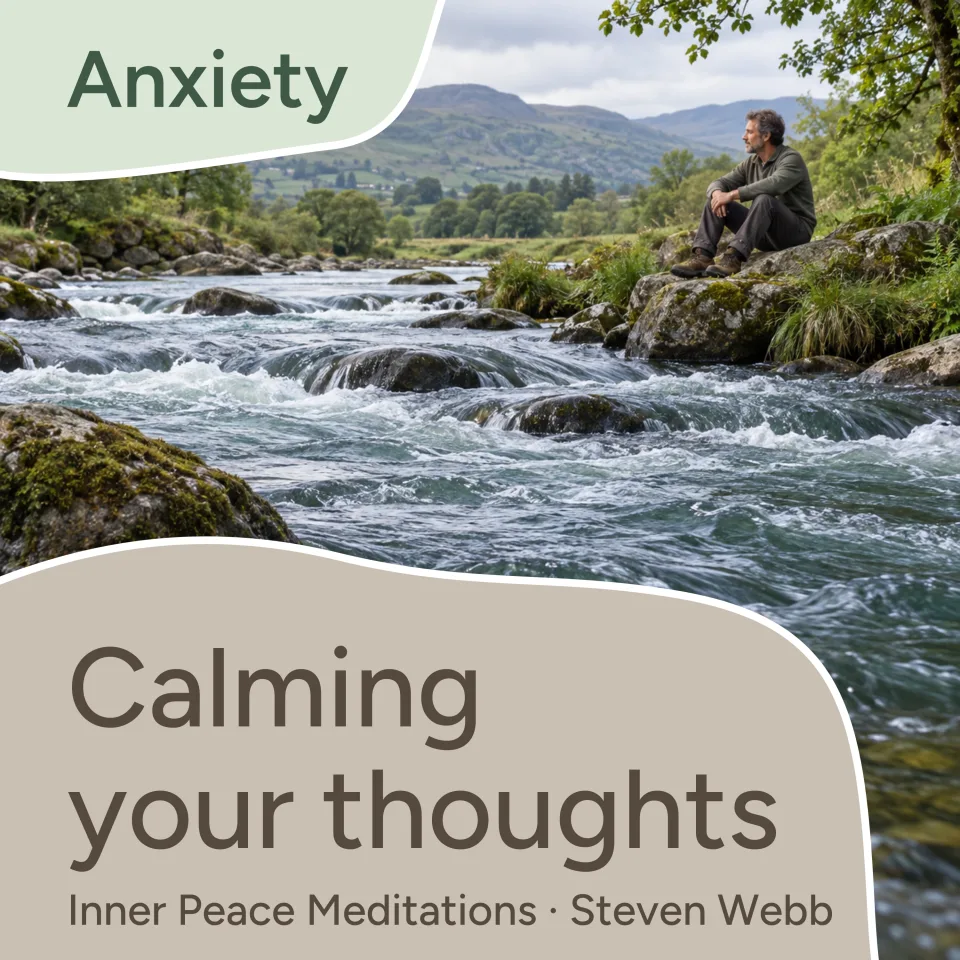
Here is what helps. A relentless thought is not one thought hanging about. It is a brand new thought each time, like a river that sounds the same and never is. So you stop wrestling it and start acknowledging it. Thank you, thought. That is all it ever wanted, the same as anyone.
Treat me to a coffee, keep the podcast free, and get my Weekly Calm every Sunday. It is all on stevenwebb.uk
Thank you for sitting with me.
Steven
Who this is for
The stubborn one. It keeps coming back no matter what you try, and trying is starting to be part of the problem.
What happens in this meditation
You settle and let the body go, a wave from the top of your head down.
Then a distinction worth having early. There is a difference between trying to make something happen and allowing it. Allowing is almost a superpower once you notice it.
Then you turn towards the thoughts. Anything clinging gets acknowledged without judgement. The mind evolved to think. It is doing its job.
Then the platform, trains in and trains out, and you sit and watch rather than boarding.
Then the part that changes it.
A relentless thought is not one thought hanging about. It is a brand new thought each time. Like a river that sounds the same and never is.
Then some lines. I have thoughts, but I am not those thoughts. May I be at peace with my mind. May I find ease in letting go.
How to get the most from it
Fourteen minutes, and the acknowledging is the mechanism rather than a nicety.
Do not label the thought good or bad or wanted or unwanted. Just thank you. That is all it was ever after, the same as anybody.
Then take it out with you. Take a seat, even a metaphorical one, take a breath, and say thank you for the thought. Sometimes you will need to do it more than once, and each time with a bit of warmth.
Questions people ask
Is it really a new thought each time?
It is, and noticing that is what loosens the grip. You have been wrestling one immovable object that is actually a stream of separate ones.
Why thank a thought I do not want?
Because the thanking is what stops the fight, and the fight is what feeds it. Doing it kindly matters more than doing it correctly.
What if it comes straight back?
Say it again. Some of them need several goes, and what changes first is not the frequency but how much hold each one has on you.
Read along
The transcript
It follows the audio. Press any line to jump there.
overthinking · mindfulness · breath
Read the transcript
Hello and welcome to this guided meditation.
This meditation is to really help you deal with those persistent and relentless thoughts. Sometimes you have a really strong
thought and it just doesn't want to go anywhere and it's really stubborn. And no matter what you try, it
just keeps coming back and coming back. This meditation will help you to step back from that thought and
Enable you to take control of your mind again and have some clarity and some inner peace. So
begin by just finding a comfortable position,
either in a seated position or a cushion or whatever is comfortable for you.
And you can choose to gently close your eyes or just soften your gaze a few feet in front of
you. It's
totally up to you.
Just become aware of your breath.
Aware that you're breathing in and
you're breathing out.
And just notice the natural rhythm of your breath.
The rising and falling of your chest.
If you're sat up, you may notice your body go forward and back just very slightly.
You don't need to do anything with your breath because your body knows how to breathe. Your
body knows what to do in this moment. It knows how to relax.
If you just allow your shoulders and your body to relax in this moment,
imagine just a wave going over with you from the top of your head right through down over your body.
Just relaxing every part of the body as it goes.
Just breathing in calm. Breathing out relaxed.
You don't need to do anything with this moment.
You're just becoming the observer and
we're becoming awareness itself and we're aware of the breath,
aware of the body, aware
of the body relaxing
And notice how your mind is just becoming more quieter.
Any thoughts do come into your mind, just allow them to be there and thank you for the thought and
allow them to go again.
There's a difference between trying to do something and allowing something to happen. When
we sit and allow our breath,
When we sit and allow our body to relax
we allow our mind to quieten and allow the thoughts to come and go,
It's almost like a superpower sitting back and just allowing things to happen.
And now gently bring your attention to your thoughts.
And if you find any mind clinging persistent thoughts... Just acknowledge them without judgement.
It could be anything.
Remembering your mind has evolved to think.
That's his job. That's his sole purpose.
To think stuff up.
To protect you.
Analyse this moment. And
to give you thoughts.
And just imagine having these thoughts and not doing anything with them.
Don't even have to pause and become aware of them.
They just arise and you can acknowledge and then they can go again.
Just like you're sat in a train station and these sorts of trains. You
can sit there all day long just watching the train come in, watching the train go out.
And notice the pauses between the thoughts.
Notice the no thinking between my words.
The quietness between breaths.
You notice how transient all these thoughts are.
And sometimes we do get relentless thoughts. Really persistent ones. And then sometimes we get these
brilliant ideas and thoughts that we
think are so great that we are never going to forget them. And
then five minutes later, they're gone. Just like that. And
we know we had a great thought,
but we cannot get back there because it's already gone.
I've got a couple of affirmations for you, and I want you to take
them at face of value exactly the words of what they say.
I have thoughts, but I am not those thoughts.
What does that look like? What does that feel like to you?
I have thoughts, but
I am not those thoughts.
With each breath, I find more space than clarity.
With each breath, I find more space than clarity.
And these affirmations really give you that ability to step back and become the observer of your thoughts.
When you do that, you notice that the thoughts aren't so much relentless, but they do come as individual thoughts.
Even a relentless thought is just a new thought every time it comes. Just
like a river. It almost sounds the same every moment, but
yet it doesn't. Every moment is different. Every
wave is different. Every thought is different
When we do this, we can be amused by the thoughts. When
we acknowledge them with a smile and thank you. And
don't label them. Don't say they're good or bad or ones you want or ones you don't want. Just thank
you. A
simple acknowledgement. That's all it wants.
Just the same as us. Just the same as anything else on Earth. Just wants to be there and to
be known.
Just the same as I believe a tree wants to be a tree hila I'm here. And
the flower wants to be a beautiful flower.
A thought just wants to be acknowledged. Thank you, thought.
It's the same as we can say thank you, body
When we do this, we take control of those thoughts. By
choosing the ones we get on and choosing the ones we just let go.
So when you have these persistent thoughts and maybe they're quite dark or not very nice or maybe they're
desires that you really don't need at that time, just
take a breath. Become aware of your breath and become aware of the thought. Thank you, thought.
I've got this.
And we're just going to deepen the practice with some affirmations to be
tailored just for this meditation.
May I be at peace with my mind
and Imagine what that feels like. Just being at peace with your mind.
May I find ease in letting go.
May I find ease in letting go.
And finally, I
have thoughts, but I am not those thoughts.
And that last one is the most powerful.
When you do that, you make the thought an object. You make it something that you're in control of.
I have thoughts, but I am not those thoughts.
So as we near the end of this meditation, start to bring your awareness back to your breath.
Breathing in calm. Breathing out relax
Notice the gentle rise of your chest and the air entering and leaving.
And gently wiggle your toes and wiggle your fingers. Bringing your awareness back to your body and slowly
bring it back to the room and gently open your eyes and look around. And
just take a moment to reflect on this practice and Thank your mind and thank your body for relaxing, breathing
just the way it needs to. And
just remember that affirmation. I have thoughts but I'm not those thoughts. So
whenever you have a relentless thought or a thought that you don't want, take
a seat. Even
if it's just a metaphorical one, if you're not able to at that time, take
a seat, take a breath and go thank you for the thought. And
then move on with whatever you're doing and you'll find the thought just floats away. And sometimes it doesn't and
sometimes you might have to do it a couple of times. But each time do it with kindness and a
smile and a joy. Even if the thought is not a desirable one, do it with kindness and a smile
and a joy.
And you'll find that they'll have less hold on you.
Thank you. I'm Steven Webb and this is the Inner Peace Meditations. And just want to thank you and
really appreciate your time. Appreciate you for leaving reviews and supporting this podcast.
Take care and have an amazing day. And hopefully a little more balanced thoughts that are not